What does the latest AI news mean for everyday users of Grok Bot, ChatGPT and Claude?
Want articles like this for your own video to promote it on YouTube and Google? Order them through the Telegram bot @sat_sit_bot. It writes articles around your video, embeds the video and publishes them on popular niche websites (no ads). Your first 50 articles are free.
· based on the channel Paul J Lipsky
Key takeaways
- Grok Bot is being positioned as an orchestrator that can call on Claude, Midjourney and Suno rather than a single all-in-one model.
- ChatGPT is rolling out an Intelligent UI that changes how chats, tools and models are presented to users.
- Claude Cowork moves to the cloud, so collaborative agent work no longer depends on a local machine staying awake.
- Google is adjusting Gemini plan tiers and shipping Nano Banana 2.1 for image generation; Google Playground was tested hands-on.
- Okou is the sponsor of the weekly recap and offers 20% off one month of Pro or Team with code KJZN8RVG, limited to 100 redemptions.
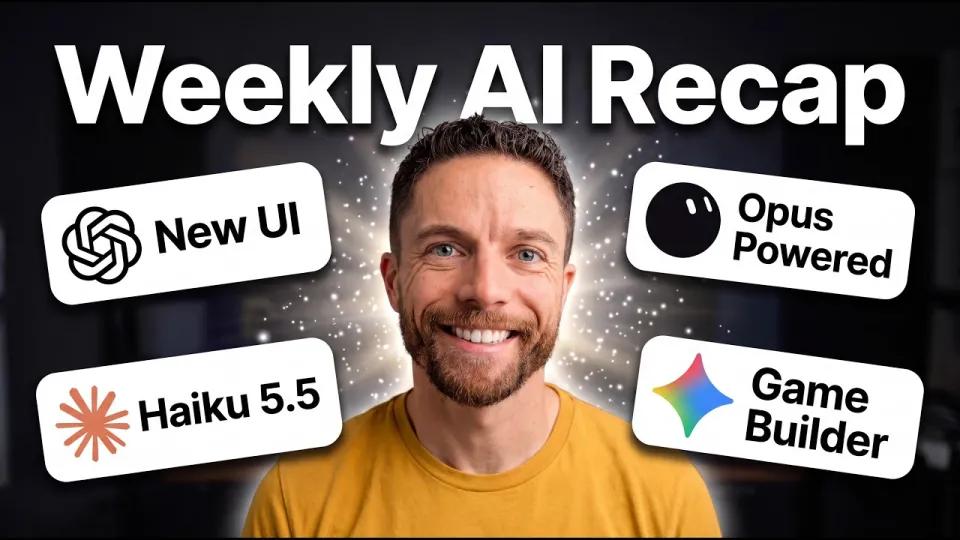
The latest AI news is less about one model getting smarter and more about tools learning to work together: Grok Bot is being set up to call on Claude, Midjourney and Suno, ChatGPT is getting a redesigned Intelligent UI, and Claude Cowork is moving to the cloud. Paul J Lipsky's weekly recap walks through those shifts alongside Google's Gemini plan changes and Nano Banana 2.1, and the episode is sponsored by Okou, which you can try via the Okou registration page. The practical takeaway for anyone following AI: the value is moving from picking a single best model to wiring several specialized tools into one workflow.
Why Grok Bot routing to Claude, Midjourney and Suno matters
Grok Bot's plan to use Claude, Midjourney and Suno is the week's most consequential story because it reframes Grok as an orchestrator rather than a standalone chatbot. In that setup, a request can be handed to a different model or service depending on the task: text reasoning to one system, image generation to another, audio to a third. For users, the appeal is consolidation — one place to start a job instead of five browser tabs and a pile of subscriptions.
There are real trade-offs to watch:
- Quality depends on the weakest link. If the routing picks the wrong tool, the output degrades even when each individual model is strong.
- Cost and limits compound. Each handoff to an external service can carry its own quota or price, so heavy users need to track usage across providers.
- Data handling gets murkier. Content passed between services may fall under different retention and training policies, which matters for business material.
- Reliability is a moving target. Multi-service pipelines fail in more places than a single model, so expect occasional partial results.
Viewer experience already hints at what this looks like in practice: one user described handing a bot a folder of business videos, asking for a social clip, receiving a voice script, recording it and getting a finished result that beat paid work. That is the promise of agent-style tools — and the reason orchestration, not raw benchmark scores, is the story to follow.
What ChatGPT's Intelligent UI actually changes
ChatGPT's Intelligent UI is a redesign of how the interface presents models, tools and conversations rather than a new underlying model. The goal is to reduce the friction of choosing between modes: instead of forcing users to know which setting to toggle, the interface surfaces the right capability for the task at hand. In practice, that means fewer menus and more contextual suggestions about what ChatGPT can do next.
For regular users, the changes worth testing are straightforward. Check whether your default model selection has shifted, since a redesign often resets preferences. Look at how attachments and tools are exposed in a new chat, because that is usually where the biggest layout changes land. And if you work in a team, verify that shared settings and custom instructions survived the update — interface changes are exactly when configuration drift shows up. The headline is cosmetic to some, but interface design decides which features people actually use, and that has a bigger effect on daily output than a modest benchmark bump.
Claude Cowork moves to the cloud and what it enables
Claude Cowork moving to the cloud means collaborative agent work no longer requires a local machine to stay powered on and connected. Cloud execution is the difference between a demo and a tool: tasks can run on a schedule, survive a laptop lid closing and be shared across a team without everyone installing the same environment.
The implications are practical. Teams can assign a piece of recurring work — summarizing incoming documents, drafting status updates, processing a batch of files — and let it run in a shared workspace. Access control becomes the critical design question, because a cloud agent acting on shared files needs clear boundaries about what it can read and change. Anthropic's broader direction, pairing capable models with agentic workspaces, also explains why so many viewers asked for a plain-language walkthrough of Claude Code: the tooling is getting more powerful faster than non-technical users can absorb it.
Google's Gemini plan changes, Playground and Nano Banana 2.1
Google's week centered on packaging and image generation: Gemini plan changes, a hands-on test of Google Playground, and the arrival of Nano Banana 2.1. Plan restructuring matters more than it sounds, because it determines which model tiers and storage bundles you get for the money. One viewer pointed out that a Google AI Plus plan includes 2TB of storage alongside access to Pro-tier models — the kind of bundle detail that changes the value calculation for people already paying for cloud storage.
Nano Banana 2.1 continues Google's push on image generation and editing, where small version increments tend to deliver noticeable gains in prompt adherence and consistency. Playground, meanwhile, is best treated as a testing ground: useful for comparing outputs quickly, less useful as a production workflow until you know how its results differ from the main Gemini app. If you are on a Gemini plan, the sensible move is to check your tier, confirm which models you can access and compare the bundle against what you actually use before renewing.
Common questions from people following AI news weekly
Weekly recaps trigger the same practical concerns each time, and three stand out. First, discoverability: a bot that appears in your workspace without a clear label can look like something went wrong, and at least one viewer deleted an unfamiliar assistant before realizing what it was — a reminder to read release notes before cleaning up. Second, skill gaps: repeated requests for beginner-friendly Claude Code tutorials show that agentic coding tools are being adopted by people who do not write code, and documentation has not caught up. Third, plan economics: users want to know exactly which model tier sits inside which subscription, because bundle details are often buried.
The common thread is that the news cycle moves faster than onboarding. A reasonable habit is to spend ten minutes after each major update checking defaults, permissions and plan entitlements, rather than discovering the changes when something breaks mid-task.
How to keep up without chasing every release
Keeping up with AI news works better as a weekly routine than a daily scroll. Pick one recap, note only the changes that touch tools you already pay for, and test one feature before the next cycle arrives. Prioritize orchestration updates like Grok Bot's multi-service routing and cloud execution for Claude Cowork, since those change what is possible rather than just what is polished. Treat interface redesigns such as ChatGPT's Intelligent UI as a prompt to re-check your settings, and treat plan changes at Google as a prompt to re-check your bill. Everything else can wait a week.
Final thoughts
The through-line in this week's AI news is integration: Grok Bot reaching for Claude, Midjourney and Suno, ChatGPT reorganizing its interface around tasks, Claude Cowork running in the cloud and Google reshuffling Gemini tiers around Nano Banana 2.1. None of these is a single dramatic leap, but together they show where the market is heading — toward tools that coordinate rather than compete on one benchmark. Paul J Lipsky's weekly format is a useful filter here, because it groups the chaos by company and keeps the practical details in view. If you want to test one of the tools featured in the episode, you can start with Okou's site and sign-up, and the promo code KJZN8RVG takes 20% off one month of Pro or Team, capped at 100 redemptions. Watch the full recap on Paul J Lipsky's channel for the hands-on segments, then pick a single workflow to improve this week.
Questions & answers
Is Grok Bot replacing Claude, Midjourney and Suno?
No. The plan described in the recap is for Grok Bot to use those services as part of a broader workflow, routing tasks to the tool best suited for them. Claude, Midjourney and Suno continue to operate as separate products with their own subscriptions and policies.
Do I need to relearn ChatGPT after the Intelligent UI update?
Mostly no. The Intelligent UI changes how models and tools are presented, not the fundamentals of prompting. Check your default model, custom instructions and any team settings after the rollout, since interface updates are a common moment for preferences to reset.
What does cloud hosting add to Claude Cowork?
Cloud execution lets collaborative agent tasks run without a local machine staying on, so scheduled and shared work becomes practical. The trade-off is that access control and data boundaries need to be set deliberately, because the agent can act on shared files.
Is a Google AI Plus plan worth it if I already pay for storage?
It can be, since the plan bundles storage with access to higher model tiers, which changes the math for people already buying cloud space. Compare the bundle against your actual usage before renewing, and confirm which models your tier includes.
Source: Weekly AI Recap: GrokBot Just Did the Unthinkable, ChatGPT Looks Completely Different & More! · Markdown version