How to understand Bill Gates's AI warning about cyberattacks, bioterror and jobs
Want articles like this for your own video to promote it on YouTube and Google? Order them through the Telegram bot @sat_sit_bot. It writes articles around your video, embeds the video and publishes them on popular niche websites (no ads). Your first 50 articles are free.
· based on the channel The Ezra Klein Show
Key takeaways
- Gates calls AI the most dangerous technology humanity has approached, saying it makes nuclear weapons look minor by comparison.
- He names two thresholds to watch: AI-enabled cyberattacks and bioterrorism, where a small group could cause mass casualties.
- Industry self-regulation is, in his words, "insane"; he wants government licensing and liability instead of lawsuits after the fact.
- His foundation will spend down roughly $200 billion over two decades, with AI-driven inequality as a new priority.
- He warns of mass job loss and floats ideas such as taxing AI labor and "human reserved" roles.
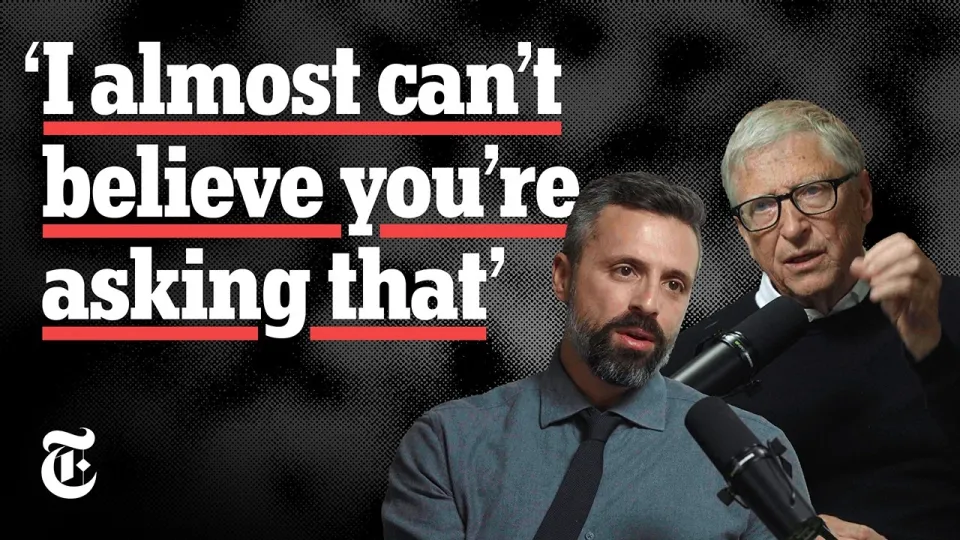
Bill Gates's core answer is that AI is the most dangerous technology humanity has ever approached, that the danger is closer than most leaders admit, and that self-regulation by the industry will not contain it. In his conversation with Ezra Klein, he argues that AI-enabled cyberattacks and bioterrorism could cause casualties on a scale that makes nuclear weapons look modest, and that only government action — licensing, liability and international coordination — can change the trajectory. The full transcript of the conversation is available at the New York Times page for the episode.
Gates arrives at this position from an unusual direction. As a technologist who spent decades arguing that computing would be a force for progress, he now says the alarmism he hears from AI critics has not gone far enough. That reversal is the spine of the episode: the man who helped build the personal computer era is less optimistic about artificial intelligence than many of the people building it today.
What changed Gates's mind about artificial intelligence
Gates's shift came from watching models cross thresholds he did not expect so soon. He describes a period in which AI systems began to perform tasks — reasoning, coding, scientific problem-solving — at a level he had assumed was years or decades away, and he treats that jump as evidence that the curve is steeper than institutions can absorb. The practical consequence is timing: if capability doubles faster than regulators can write rules, then the window for getting safety architecture right is short.
He is careful to separate two claims that are often blurred. The first is that AI will produce enormous benefits in medicine, education and productivity. The second is that the same systems create risks that markets alone will not price. Gates holds both at once, which is why he rejects the framing that anyone worried about AI must be against it.
The two thresholds Gates says matter most
Gates points to cyber and bio as the domains where AI changes the math of catastrophe. In cybersecurity, he argues that AI lowers the cost of finding and exploiting vulnerabilities, shifting the advantage toward attackers and away from defenders who must protect every door. In biology, he warns that tools which help design drugs and proteins can also help design pathogens, and that the knowledge barrier is falling fast.
His test for severity is blunt: a scenario in which a small group could kill tens of millions of people is not a hypothetical to be litigated later. When Klein raises the idea of holding companies accountable through courts, Gates's response is that a lawsuit is no answer to a catastrophe of that size — the harm would already be done. That is the argument behind his demand for pre-deployment oversight rather than post-disaster litigation.
Why Gates calls AI self-regulation insane
Gates rejects the position, associated in the conversation with Nvidia's Jensen Huang, that market incentives and reputational pressure will keep AI companies from causing harm. His objection is historical: industries from tobacco to opioids to fossil fuels have shown that profit and safety diverge, and that voluntary commitments erode under competitive pressure. If one lab slows down and another does not, the cautious one loses, so caution has to be imposed from outside.
What he wants instead looks like a licensing regime:
- Governments certify that a model or training run above a capability threshold meets safety requirements before release.
- Developers carry legal liability for foreseeable harms, so risk is priced into decisions rather than externalized onto the public.
- International agreements set red lines, particularly around biological and cyber capabilities, because a national rule means little when models can be trained anywhere.
- Independent evaluators, not the companies themselves, run the dangerous-capability tests.
Gates is explicit that this is not about banning progress. He wants the benefits, including in health and education, and thinks a slow, poorly designed clampdown would cost lives too. The dispute is over who bears the burden of proof before deployment.
The race with China and the cost of going slow
The competitive argument cuts both ways, and Gates does not pretend otherwise. If the United States unilaterally slows down while China does not, the safety gains may be offset by a shift in who sets the norms. His answer is that coordination has to include rivals, in the way nuclear arms control did, and that the alternative — a race in which every participant skips safety checks to keep pace — is the worst outcome for everyone.
This is where his view differs from both poles of the current debate. He is not arguing for a pause on capability research, and he is not arguing that the market will sort it out. He is arguing that the rules of the race need to be written before the finish line matters, and that the countries capable of building frontier systems have a shared interest in not handing bioweapons or cyberweapons to anyone with a grievance.
Jobs, inequality and the case for taxing AI labor
Gates expects AI to disrupt work faster than previous general-purpose technologies, and he is skeptical that new job categories will absorb displaced workers at the same rate. He describes a possible no-scarcity labor market in which goods and services are cheap but the link between work and income weakens, and he treats that as a political problem rather than a purely economic one.
Among the tools he raises are taxes on AI labor — a way to fund redistribution as machine output substitutes for human wages — and the idea of "human reserved" jobs, roles in care, education and public service where people may deliberately choose human providers. He also flags the global dimension: developing economies that were counting on low-cost labor as a ladder may find the ladder pulled up, and the Gates Foundation has made AI-driven inequality a new priority, alongside a planned spend-down of roughly $200 billion over the next two decades.
Education, children and the regulation gap
Gates sees education as the clearest near-term upside and the clearest evidence of institutional lag. Tutoring that was once available only to wealthy families can become cheap and personalized, but schools in rich countries are still absorbing learning loss from the pandemic, and adding AI without guardrails risks widening gaps rather than closing them. He argues for measurement and evidence rather than enthusiasm.
On children, he takes a position closer to regulation than most of the industry: age-appropriate design rules, limits on engagement-optimized systems, and parental visibility into what AI companions are telling minors. The same logic that makes him skeptical of self-regulation for frontier models applies to consumer products, where the harms are quieter but widespread.
Questions listeners keep raising
The conversation produced visible discomfort, and much of it is worth taking seriously. One recurring reaction is that Gates seems more agitated than audiences expect, which itself is a signal: the person with the most to gain from AI optimism is describing a narrow window. Another is the exchange over lawsuits, where his impatience with after-the-fact remedies is unmistakable. A third is the question of whether capitalism can police itself; Gates's answer, grounded in a century of industrial harm, is no. And a fourth is the simple arithmetic of fear — if someone with his knowledge of the technology is worried, the burden shifts to those who are not to explain why.
Klein's role in the episode is to press rather than to agree, and the result is a more useful document than a consensus interview would be. The disagreements are left in, including the moments where Gates pushes back hard on the premise of a question.
Useful links
- Full transcript of the Bill Gates conversation on The Ezra Klein Show
- Book recommendations from guests of The Ezra Klein Show
The bottom line
Gates's argument is that AI capability is outrunning the institutions meant to govern it, and that the two places where that gap could turn catastrophic are cyber and bio. He rejects self-regulation as a fantasy, wants licensing and liability before deployment, and expects job disruption severe enough to require new redistribution tools. The conversation, produced by The Ezra Klein Show, is worth reading in full because the disagreements are as instructive as the conclusions — and the transcript is free to read at the episode page.
Questions & answers
Why does Bill Gates compare AI to nuclear weapons?
He argues that AI-enabled cyberattacks and bioterrorism could cause casualties on a scale that exceeds nuclear war, and that the technology is spreading faster than the treaties and agencies that constrained nuclear weapons. The comparison is about consequence and speed, not about the technology being identical.
Does Gates want to stop AI development?
No. He expects large benefits in medicine, education and productivity and opposes a blanket pause. What he wants is pre-deployment testing, licensing above capability thresholds and legal liability, so that safety is a condition of release rather than an afterthought.
What does he mean by taxing AI labor?
As machine output substitutes for human wages, the link between work and income weakens. Gates raises taxes on AI labor as one way to fund redistribution and public services, alongside ideas such as human reserved roles in care and education.
How does the Gates Foundation plan to address AI inequality?
The foundation has made AI-driven inequality a new priority and plans to spend down roughly $200 billion over two decades. The focus is on making the benefits reach developing economies and poor communities rather than concentrating them where compute and capital already are.
Source: Bill Gates: A.I. ‘Makes Nuclear Weapons Look Like Nothing’ | The Ezra Klein Show · Markdown version